
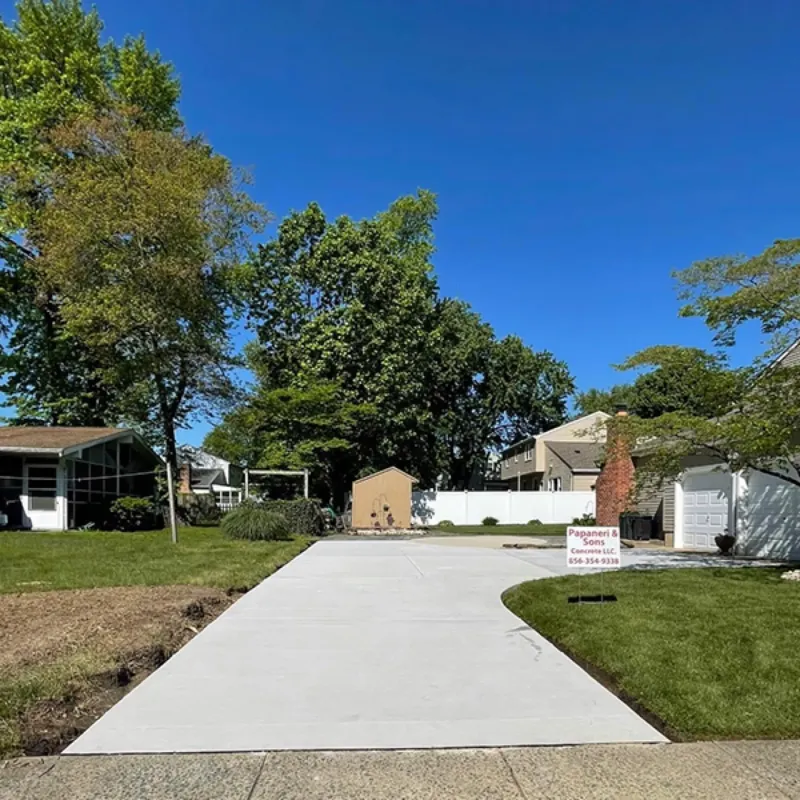
A well-built concrete driveway lasts 25 to 30 years, and cold winters and road salt can cut that to about 20. Here is what decides it and how to tell when yours is close to done.
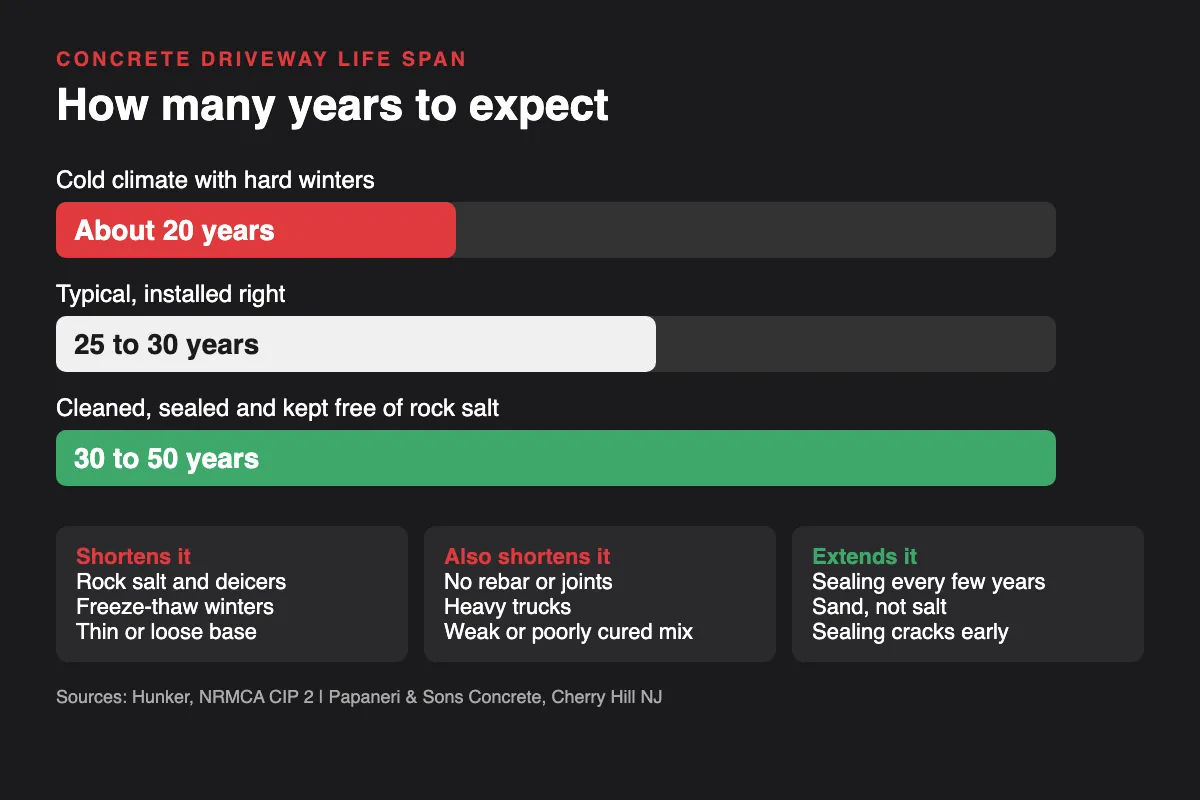
Most concrete driveways last 25 to 30 years when they are installed correctly. In cold climates with hard winters, about 20 years is a fair number. With good care, a driveway can reach 30 to 50 years.
The range is wide because the pour is only part of the story. The base, the mix, the joints, the winter and the way you treat the surface all add or take away years. Our driveway repair work starts with finding out which of those is wearing a slab down.
This guide covers the typical life span, what shortens it, what we see in South Jersey, and the signs a driveway is near the end.
A well-built concrete driveway typically lasts 25 to 30 years, based on what we see across hundreds of South Jersey driveways. Cold climates with intense winters bring that closer to 20 years, since more freeze-thaw cycles and road salt take a bigger toll.
Care moves the number the other way. Regular cleaning, resealing and prompt crack sealing, the maintenance NRMCA recommends for slabs facing winter, can stretch a driveway from 30 years toward 50.
Think of 25 to 30 years as the middle of the road. A driveway poured on a firm base with the right mix and joints can beat it. One poured on a thin base, or salted every winter, can fall short of it.
A long-lasting driveway begins under the concrete. A compacted stone base lets water drain away instead of sitting under the slab. Reinforcement and control joints guide cracks to straight lines. A strong mix, cured properly, gives the surface a hard skin that wears slowly.
Where the driveway sits matters too. A slab in full shade stays damp longer, and a slab at the bottom of a slope collects runoff. Both can age faster than a dry, sunny driveway poured the same day.
Thickness matters too. We cover it in our guide on driveway slab thickness.
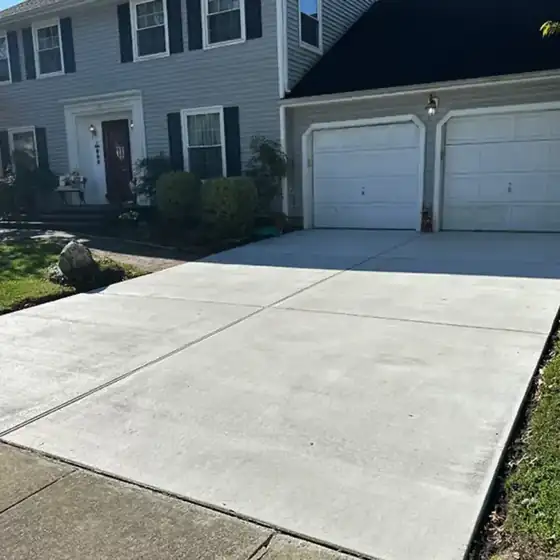
Six things do most of the damage. Some happen on pour day and some happen every winter.
Water works its way into the tiny pores in a slab. Each time it freezes it expands and pushes outward, and a slab that goes through dozens of freeze-thaw cycles a winter ages faster than one that does not.
Rock salt and other harsh deicers keep a slab wet longer, which means more freeze-thaw cycles before it has a chance to dry out. Fertilizer spilled on the slab can eat at it too.
A base that is not compacted, or does not drain, lets the slab settle and crack. Slabs poured without rebar or wire mesh tend to open up faster.
Control joints are cuts that tell the concrete where to crack. Without them, or with them spaced too far apart, cracks wander across the slab.
A driveway is built for cars and light trucks. Concrete trucks, dumpsters and heavy equipment can crack a normal slab.
Concrete needs the right strength, tiny air bubbles for freeze protection and proper curing. NRMCA says concrete exposed to deicers should be about 4000 psi and air-entrained, and that skipped curing is a common cause of scaling.
The chart below shows the usual ranges and what pushes a driveway toward the short or long end.
South Jersey sits right in the zone where winter swings back and forth across freezing. Rain, a freeze, a thaw, then rain again. That is hard on concrete.
Papaneri & Sons has poured and repaired concrete in Cherry Hill since 1987. The family crew has seen the same pattern many times. A driveway looks fine in November and shows new cracks and rough patches by April.
The driveways that age best are the ones with a solid base, a strong mix and a sealer. NRMCA's guidance for slabs facing winter is to keep deicing salts off new concrete in its first winter and seal the surface. Sand gives traction without the damage.
The oldest slabs we see are usually the ones nobody sealed. They have wide cracks, a worn surface and joints that have opened up. Water gets in at every one of those spots, and that speeds up the next round of damage.
Small habits help as well. Shovel snow instead of salting it, keep downspouts pointed away from the slab, and fill hairline cracks before winter. Each one keeps water out, and water is what breaks concrete down.
Most homeowners in Cherry Hill never think about the driveway until a crack shows up. A quick look each spring is enough to catch problems while they are still cheap to deal with.
A sealer is the cheapest way to add years. Our concrete sealing service protects the surface from water, salt and stains.
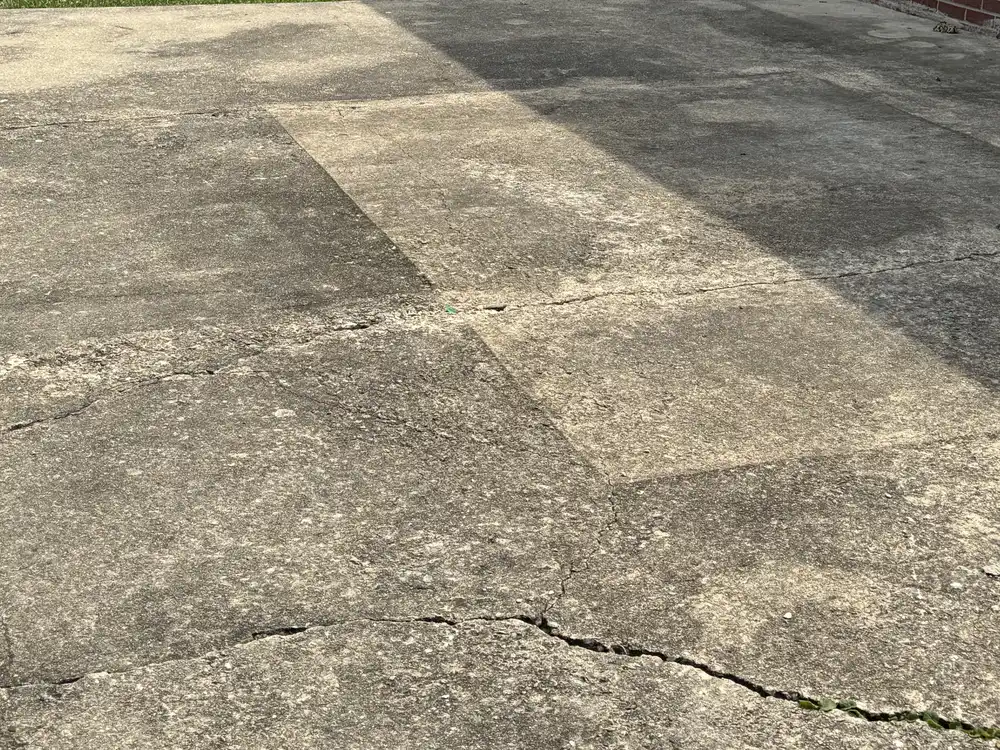
A few cracks do not mean the end. These signs, taken together, say a driveway is running out of years.
Hairline cracks are normal and can be sealed. Cracks wide enough to catch a pencil, or a web of cracks across several panels, point to a failing base.
If one panel sits lower than the next or moves under a car, the ground under it has washed out or settled. Patching the top will not fix that.
A rough, pitted surface that sheds chips every spring means the top layer has given up. Exposed gravel across large areas is a late-stage sign.
Puddles that never drain mean the slope has changed. Standing water speeds up freeze damage.
A slab past 25 years with several of these signs is at the end of a normal life span.
Not sure where yours stands? Our post on repairing or replacing a driveway covers the choice. If you are weighing materials, see concrete versus asphalt driveways. For a look at your own slab, call us for a free estimate.
Stains are the other thing people ask about. See getting oil stains out of a driveway.
Most last 25 to 30 years, and closer to 20 in cold climates. Replace it when the base has failed or most of the slab is cracked, sunken or crumbling. A sound driveway with surface wear can often be repaired or resealed instead.
Yes. Sealer keeps water and salt out of the surface, which slows freeze-thaw damage. NRMCA recommends resealing a slab facing winter and keeping deicing salt off new concrete its first year. In Cherry Hill, NJ, a sealer before winter is a good habit.
Yes. Salt keeps the surface wet and adds freeze-thaw cycles. Use sand for traction, keep salt off new concrete in its first winter, and rinse salt off in spring.
Papaneri & Sons Concrete pours, repairs and seals driveways across Cherry Hill and South Jersey. Call or send a photo and we will tell you what your slab needs.