
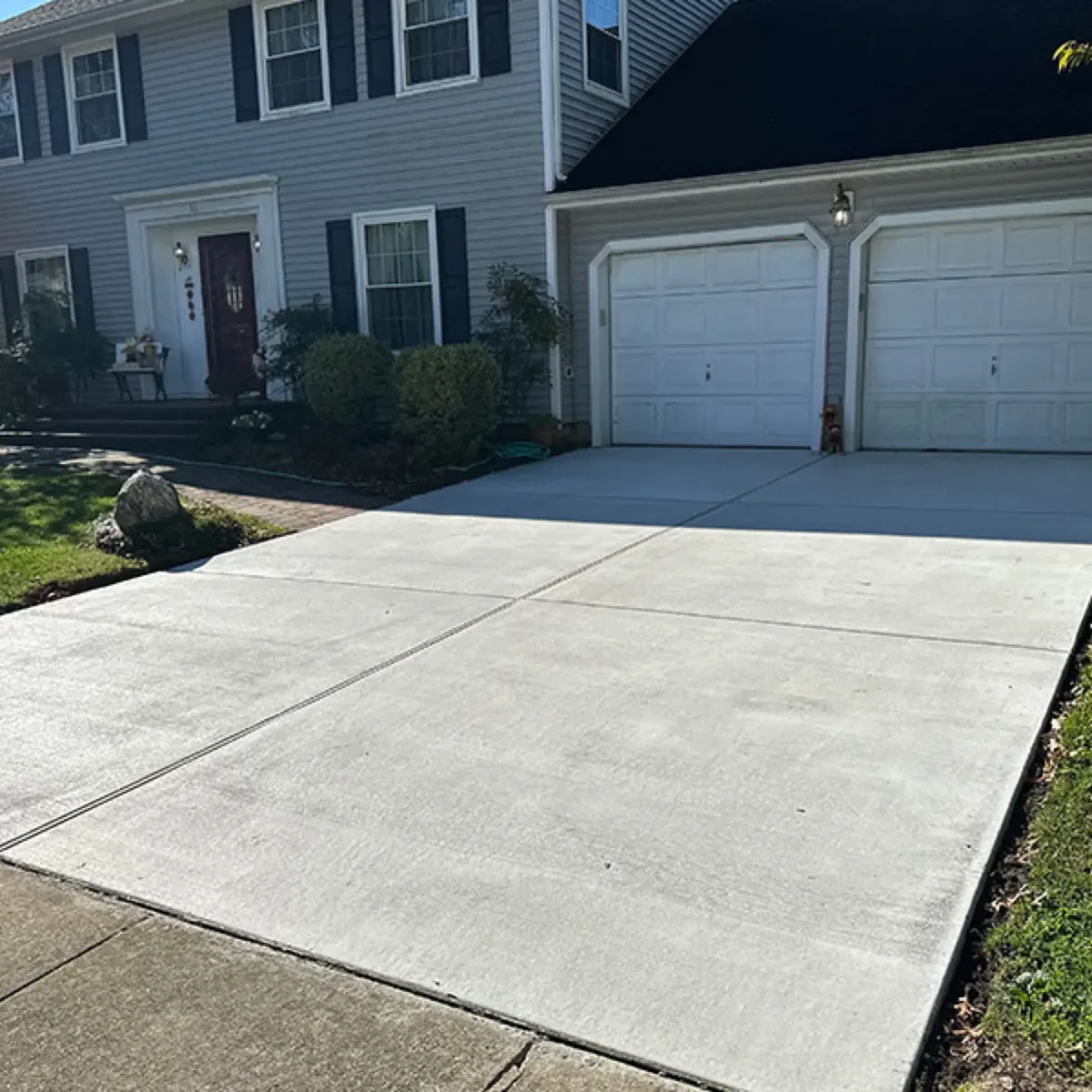
Four inches is the residential standard. What parks on the slab, and what sits under it, decides whether you need five or six instead.
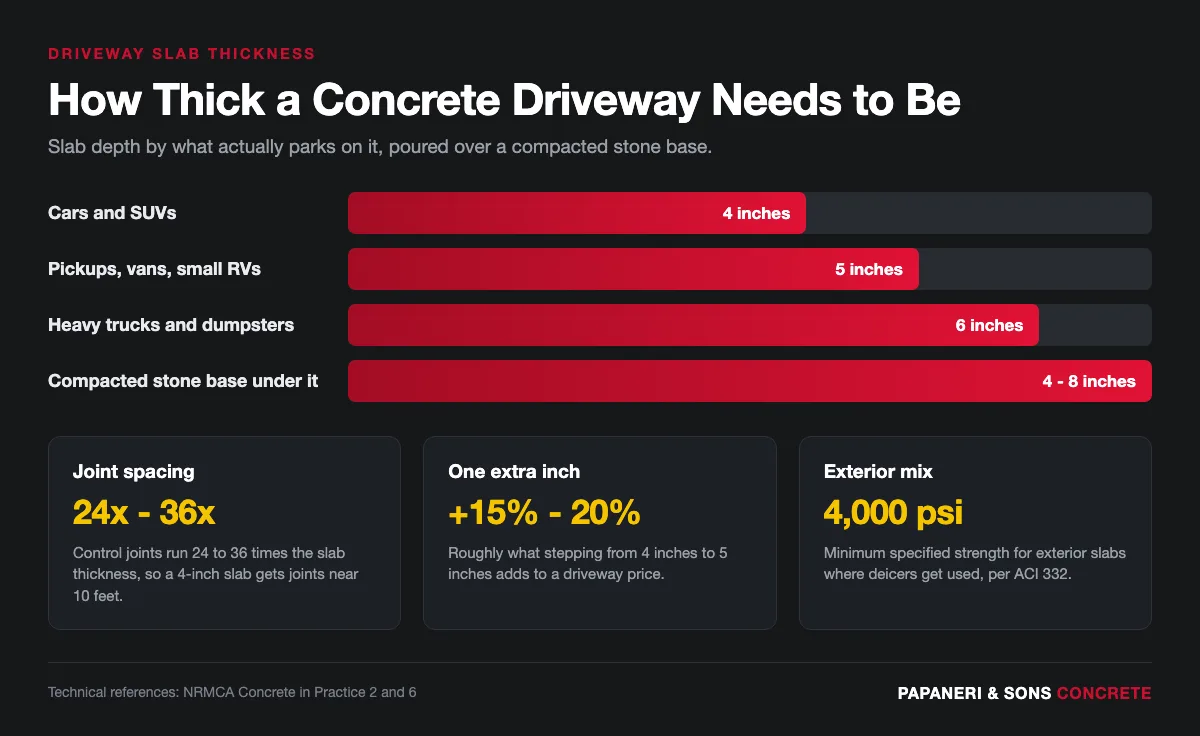
A residential concrete driveway carrying cars and SUVs should be four inches thick. Add an inch for pickups, work vans, or an RV, and go to six inches where a loaded truck or a dumpster will sit.
Papaneri & Sons has been pouring driveways since 1987, and thickness is only half the answer. A four-inch slab on six inches of compacted stone outlasts a five-inch slab poured on soft ground every time.
This post covers how to spec a driveway before you sign anything. For what a full installation includes from tear-out to final finish, see our concrete driveway installation page.
Thickness is a load question first. Work out the heaviest thing that will ever sit on the driveway, then spec from there rather than from the size of the house.
Passenger vehicles in the 3,000 to 6,000 pound range are what four inches was designed for. This is the standard on most residential jobs and what most local codes set as the minimum. On stable soil with a proper base it holds up for decades.
A three-quarter ton pickup, a loaded work van, or a small RV puts far more weight on a small patch of slab. Five inches gives that load somewhere to spread. It is the single cheapest upgrade on a driveway quote and the one most homeowners skip.
Box trucks, roll-off dumpsters, and equipment trailers belong on six inches with reinforcement. If you renovate often or park a trailer at the top of the drive, spec this section rather than repairing a cracked panel later.
The apron takes every delivery truck, every trash truck wheel, and every plow blade in the neighborhood. Many towns already require a thicker apron than the driveway behind it. Even where they do not, adding depth at the curb is money well spent.
Four to eight inches of compacted stone under the concrete is what keeps the slab supported and drained. Soft spots, buried tree roots, and old fill have to come out first. Concrete cannot bridge a void it was never designed to span.
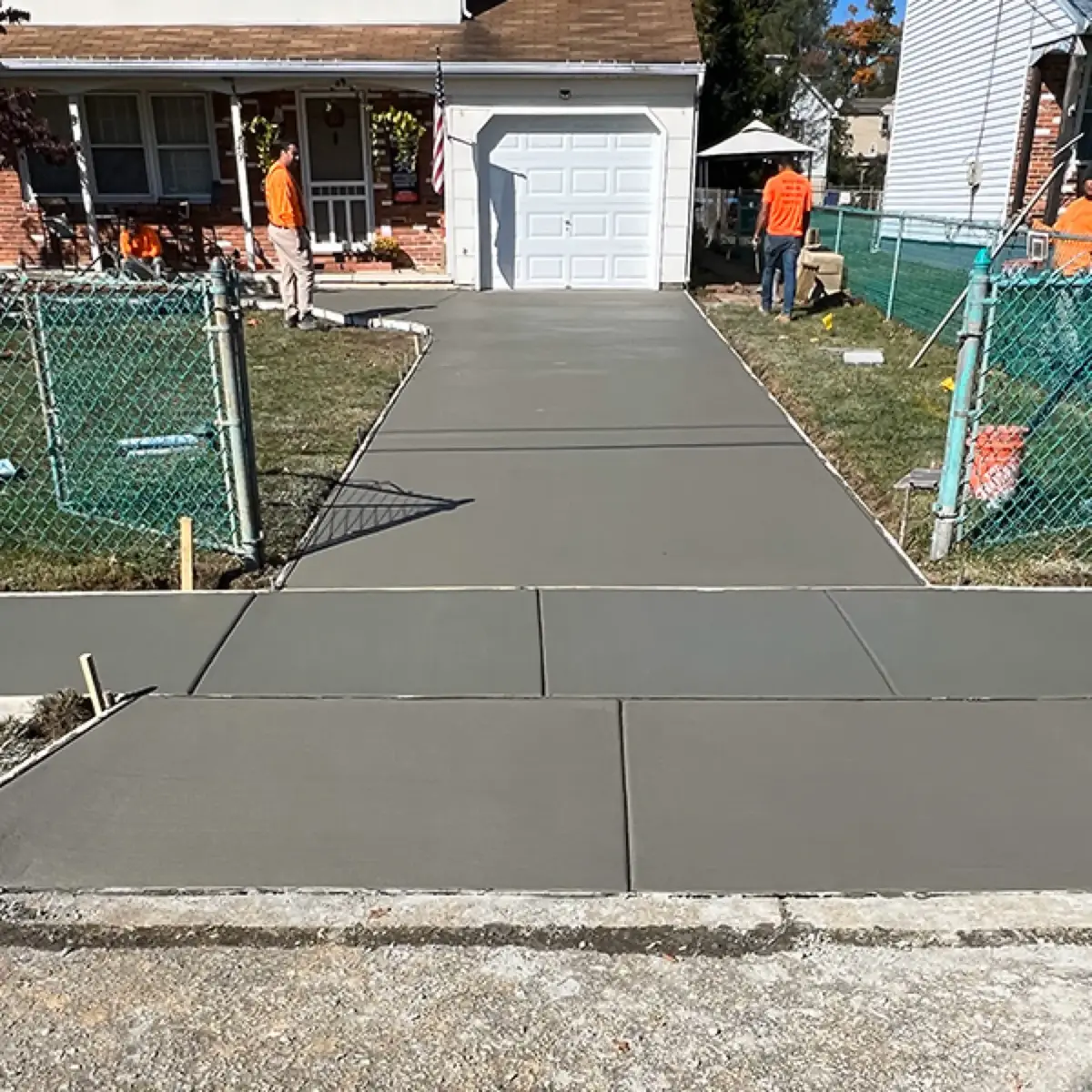
Slab depth is not only about load. It also sets where the control joints go. The National Ready Mixed Concrete Association puts maximum joint spacing at 24 to 36 times the slab thickness, and caps it at 15 feet.
A four-inch slab wants joints about every 10 feet. A five-inch slab can stretch closer to 12. Panels should be square or nearly square, with the long side no more than one and a half times the short side.
Concrete shrinks as it cures and it will crack somewhere. Joints decide whether that crack lands in a straight cut line or wanders across the middle of your driveway. Joint layout is the cheapest crack control there is.
Stepping from four inches to five adds roughly 15 to 20 percent to the concrete portion of a driveway. That is one line on one invoice, against the full price of replacing a slab that failed under a truck.
Control joints have to be cut while the concrete is still green, usually within the first day. Cut too late and the slab has already picked its own crack line. Cut too early and the saw tears the surface instead of scoring it.
Where a driveway meets the garage slab, a foundation wall, or a light post, it needs a separate isolation joint. Those elements move at their own rate, and a slab tied hard to them cracks at the seam first.
Papaneri & Sons has placed more than 5.7 million square feet of concrete, and we tear out driveways every season. Very few of them failed because the mix was bad. They failed because the slab was thin, the base was thin, or both.
The most common pattern is a driveway that looks perfect for three years, then cracks in a line right where the delivery truck backs in. That is a load failure, not a material failure. An extra inch of concrete would have carried it.
Mix strength is the other half. The National Ready Mixed Concrete Association calls for a specified strength of 4,000 psi with about 6 percent entrained air on exterior slabs exposed to deicing chemicals.
Our residential driveways go in at 4,500 psi, above that floor. Thickness carries the load and strength carries the surface, and a driveway needs both to make it through twenty New Jersey winters looking right.
Drainage is the quiet third factor. Water that sits along one edge of a driveway washes fines out of the stone base, and the slab above that spot loses its support. A driveway that puddles after every rain is telling you where it will crack.
One habit protects a new driveway more than anything else. Keep deicing salt off it for the first full winter and use sand for traction instead. The concrete is still gaining strength during that window.
Ask every bidder for three numbers in writing: slab thickness, base depth, and mix strength. A contractor who pours good driveways will give you all three without hesitating. One who will not is telling you something.
Check your town's code before you shop. Many municipalities set a minimum driveway and apron thickness, and the permit office will tell you over the phone in a minute. That number is a floor, not a target.
Ask how the joints will be laid out, too. Our page on concrete expansion joints covers where they belong and why the spacing follows the slab depth.
If your current driveway is cracking, thickness may already be the answer to the bigger question. Our guide to driveway repair versus replacement walks through the tests that separate a patch from a rebuild.
Still deciding on material? Our comparison of concrete versus asphalt driveways lines up install price, service life, and upkeep over the same thirty years.
Want the numbers? See our breakdown of control joint spacing for driveways.
A four-inch residential driveway on a good base often performs fine without it, and joint layout does more for crack control than steel does. Reinforcement earns its keep on thicker slabs, on soil that moves, and anywhere heavy vehicles park. When we do use it, the steel sits in the middle of the slab, not on the ground.
No. Past six inches you are paying for concrete that the load will never use, and a poor base will still let a thick slab crack. Money is better spent on deeper compacted stone, proper drainage, and correct joint spacing. Thickness and base work together or neither one performs.
Stay off it with vehicles for at least seven days, and closer to ten for anything heavy. Foot traffic is usually fine after 24 hours. Papaneri & Sons gives every customer a written schedule before the pour, so call (856) 354-9338 if you need the work planned around a delivery.
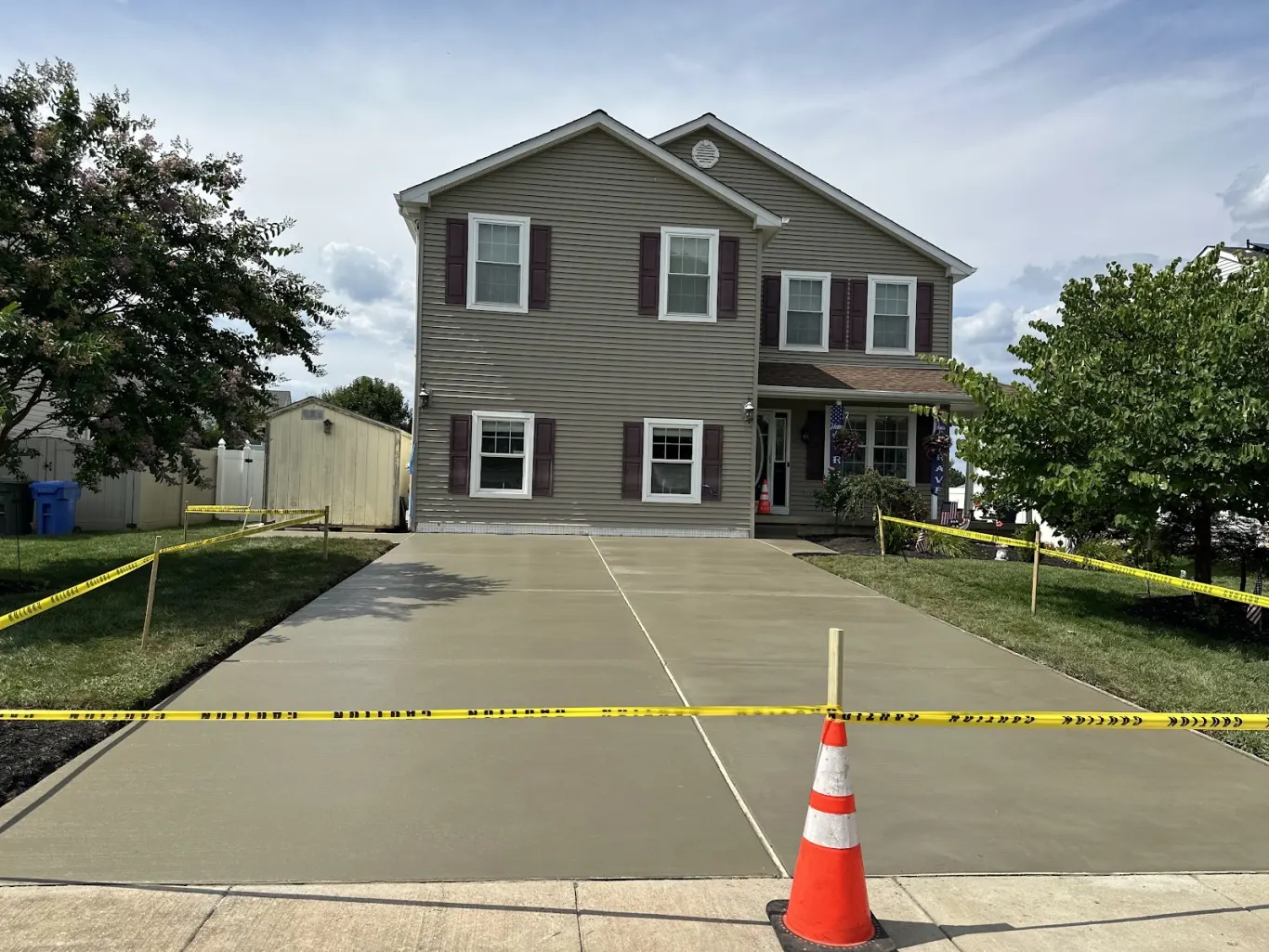
A ten-minute walkthrough settles thickness, base depth, and joint layout. We will tell you when four inches is plenty, even though five costs us more to pour. Papaneri & Sons builds driveways across Cherry Hill, Voorhees, Marlton, Mount Laurel, and Haddonfield. Family crew since 1987, free on-site estimates, 4,500 psi mix on every residential pour.