
Cold weather rules start at 40 degrees. Fresh concrete freezes near 25. The ground under it has to be frost free either way.
No single temperature bans a pour. Cold weather rules kick in at 40 degrees, fresh concrete freezes near 25 degrees, and the ground under the slab has to be free of frost no matter what the air is doing.
Concrete does not stop working when it gets cold. It slows down. A slab that freezes in its first two days can lose more than half the strength you paid for, and no amount of waiting brings it back.
Below: the four temperatures that decide a winter pour, how cold changes the mix and the schedule, and why frozen ground is the real problem. For how a footing or slab gets placed in the first place, see our concrete foundation pouring page.
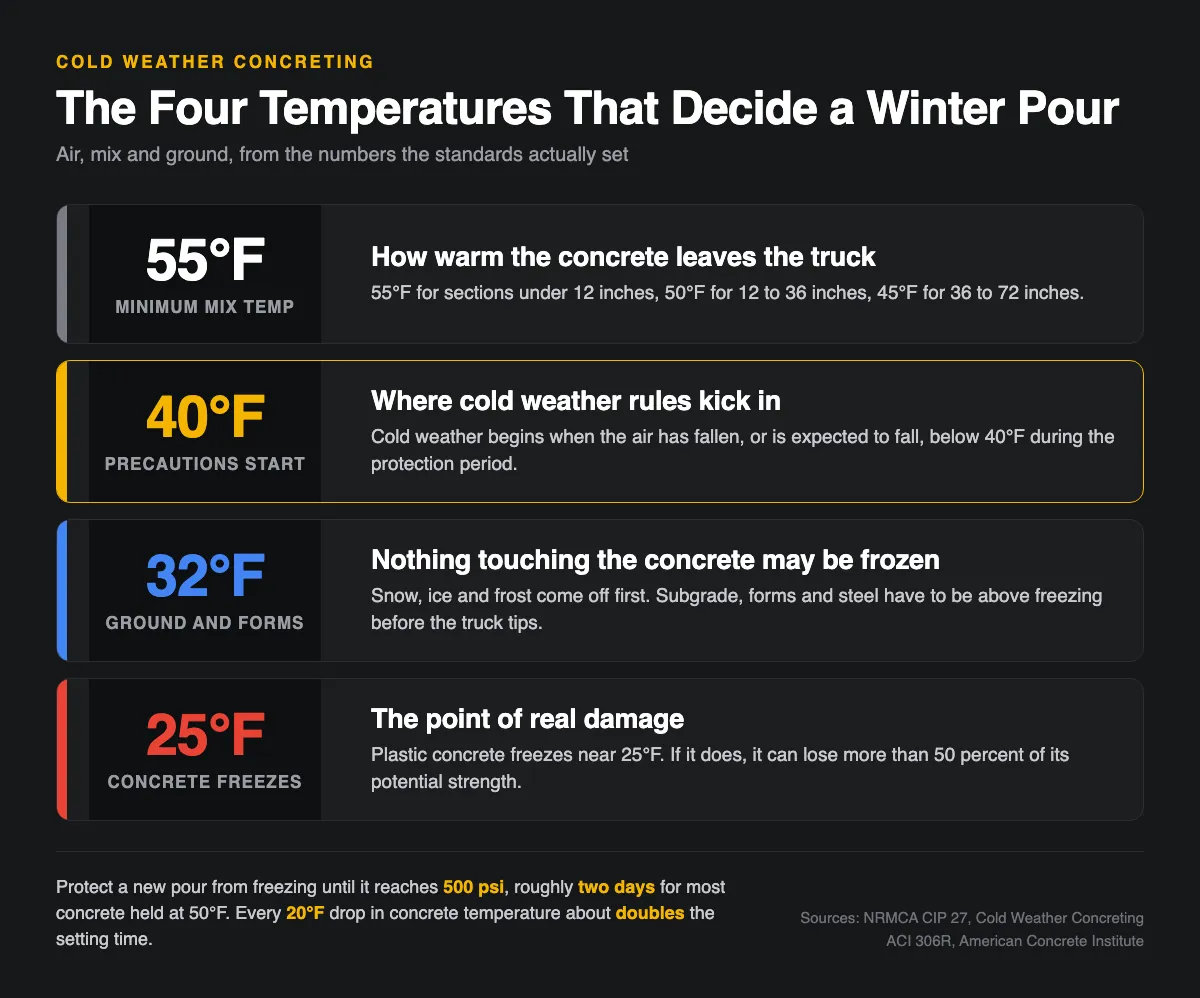
Four numbers run a cold weather pour. Only one of them is about the air.
40 degrees is the trigger, not the cutoff. The National Ready Mixed Concrete Association defines cold weather in CIP 27, Cold Weather Concreting as more than three days in a row where the average daily temperature is under 40 degrees and the air does not get above 50 degrees for more than half of any 24 hours.
The American Concrete Institute puts it a second way in ACI 306R. Cold weather exists when the air has fallen, or is expected to fall, below 40 degrees at any point in the protection period, as the Pennsylvania Aggregates and Concrete Association summarizes it. Hit either definition and you are pouring under cold weather rules.
Concrete in its fresh state freezes at about 25 degrees. CIP 27 says frozen concrete can lose more than 50 percent of its potential strength and will not be durable. That is the number that turns a cold pour into a bad pour.
Everything the concrete touches has to be above freezing. Snow, ice and frost come off the subgrade first, and the forms and the rebar have to be clear too. On a hard freeze that means thawing the ground the day before.
Townships write their own limits on top of the standards. Union County, Ohio allows a pour at 17 degrees and rising, requires the ground to be frost free, and requires insulation that holds the concrete at 50 degrees for three days. Below 17 degrees a design professional has to sign off first.
Cold weather does not only change what happens on the day. It changes what leaves the plant and how long the job runs.
CIP 27 sets the temperature the concrete should be at when it is placed, and it goes by how thick the section is. Thin work needs the warmest mix: 55 degrees for anything under 12 inches, 50 degrees for 12 to 36 inches, and 45 degrees for 36 to 72 inches, per NRMCA. A driveway, patio or sidewalk is thin work, so it needs the 55 degree mix.
The plant hits those numbers by heating the mixing water or the aggregate. It belongs in the order, not in a conversation afterward.
NRMCA's rule of thumb is that dropping the concrete temperature by 20 degrees about doubles how long it takes to set. A slab that is ready to finish at 3pm in June is still bleeding at 7pm in December.
That is why a cold pour is a long day. Nobody can finish while the slab is still bleeding water, and finishing early leaves a weak, dusty surface.
A new slab has to be kept from freezing until it reaches 500 psi, which is about two days after placement. Blankets, tarps or an insulated enclosure do that work, and corners and edges lose heat fastest.
Freeze and thaw cycles are a separate problem. NRMCA says newly placed concrete should be protected from them until it reaches at least 3,500 psi, and recent research cited by the Pennsylvania Aggregates and Concrete Association puts that bar at 4,000 psi.
Pull the blankets off slowly. A gap of more than about 35 degrees between the surface and the inside of the slab can crack it.
Papaneri & Sons Concrete has poured in Cherry Hill and across South Jersey since 1987, more than 5.7 million square feet. A good part of it went down between November and March.
Most of a South Jersey winter already counts as cold weather concreting. Philadelphia International Airport, the closest long term station to Cherry Hill, averages 38.6 degrees in December, 33.7 in January and 35.9 in February under NOAA's 1991 to 2020 climate normals. January alone averages 22 nights at or below freezing.
Frost swells the ground. Pour a slab on it and the subgrade lifts, then drops away in the thaw, and the slab is left bridging a gap it was never designed to bridge. The crack shows up in March, not in January.
We check the subgrade by hand before anything is ordered. If there is frost in it, the ground gets thawed and recompacted first, or the pour moves. There is no third option that ends well.
We pour a 4500 PSI mix on every job, year round. Most crews in this area pour 3500 to 4000. In winter that extra strength is doing real work, because the slab is racing a forecast instead of a calendar.
Mario Papaneri Sr. founded the company in 1987 and still supervises every pour. On a cold job that means blankets on the truck before it leaves, not after someone notices the temperature dropped.
We would rather lose a week than hand a homeowner a slab that was fighting the weather. A pour pushed to the next warm stretch costs nothing. A slab that froze on night one gets cut out and replaced.
You do not need a thermometer to make this call. You need four answers from whoever is pouring.
Ask for the forecast through the whole protection period, not just pour day. A 48 degree afternoon followed by two nights in the twenties is worse than a steady 38 degrees.
Ask what temperature the plant will deliver the concrete at. If nobody has asked the plant for a heated mix, the order is not a cold weather order.
Ask what the protection plan is and how long it stays on. Blankets, how many layers, and which day they come off. Curing and protection are not the same job, and our guide to concrete curing methods covers the curing half.
Ask what mix is going down. Strength is what buys margin when the weather is against you, and what a 4500 PSI mix is explains what that number actually gets you.
A protected winter pour lasts as long as a June one. A rushed one cracks, and most of those cracks start in the first week, the pattern in our guide to concrete cracking.
Winter is hard on finished concrete too. De-icing salt does its own damage to a slab that is already down.
Yes, with protection. 30 degrees is above the 25 degree point where fresh concrete freezes, so the pour works as long as the ground is frost free, the mix leaves the plant warm enough, and the slab is blanketed until it reaches 500 psi. Without that protection, 30 degrees is a bad bet.
The water inside it expands and breaks apart the structure that is still forming. NRMCA puts the loss at more than 50 percent of the concrete's potential strength, and the slab will not be durable. There is no patch. The section gets cut out and repoured.
Not usually. Most of a Cherry Hill winter sits in the 30s, which is workable with a heated mix and blankets. Wait for spring if the forecast has nights in the low twenties, if the ground is frozen solid, or if you want stamped or decorative work that needs warm finishing time.
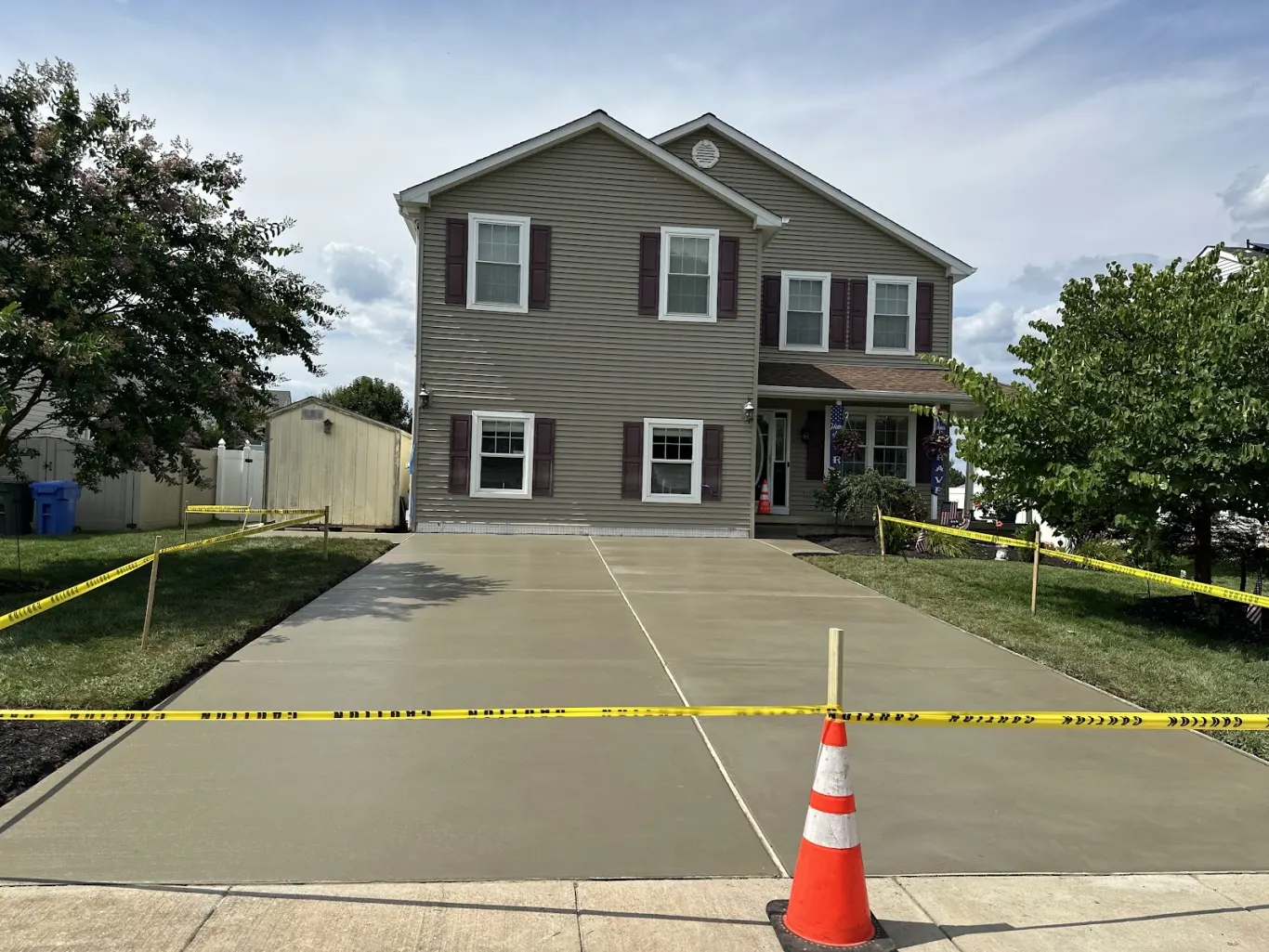
We pour driveways, patios, sidewalks, footings and slabs across Cherry Hill, Marlton, Mount Laurel, Moorestown and Haddonfield, winter included. Tell us what you are building and we will come measure it and give you a date we can actually protect.