
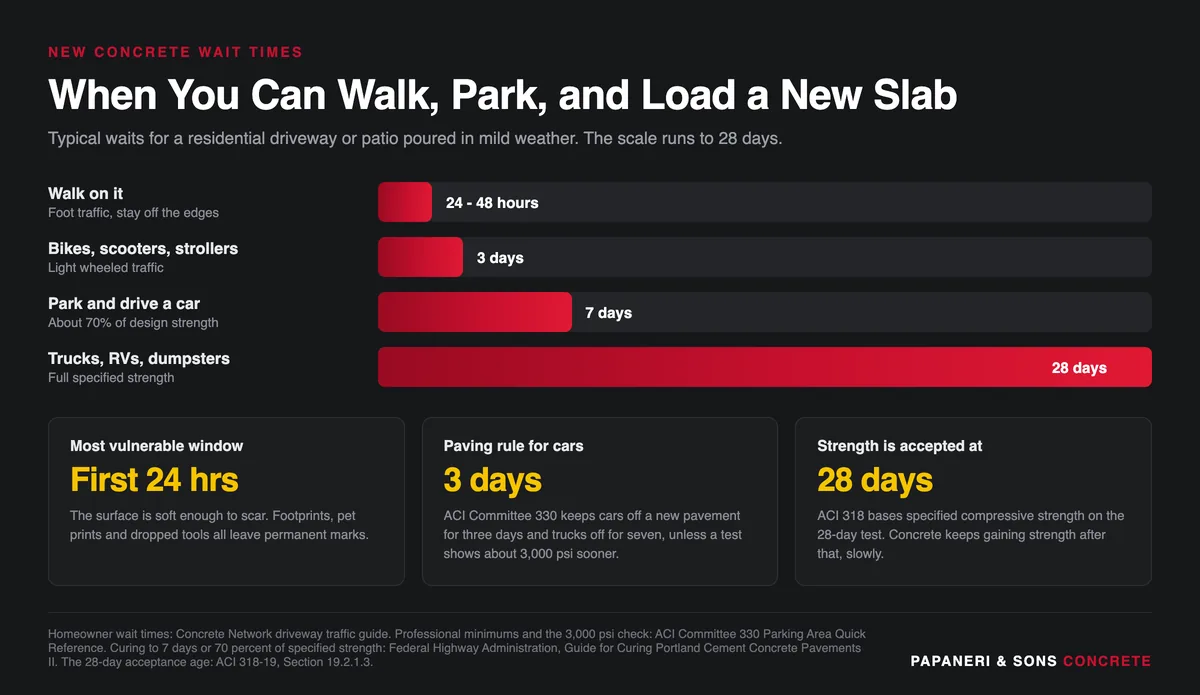
Walk on it in 24 to 48 hours. Park a car after about 7 days. Keep trucks and RVs off until day 28.
You can walk on new concrete after 24 to 48 hours, drive a car on it after about seven days, and put a loaded truck or an RV on it at 28 days. Those are the wait times Concrete Network publishes for a new driveway.
Concrete is hard enough to stand on long before it is strong enough to carry a car. That gap is where most of the damage happens.
This post covers the wait for each kind of traffic, why 28 days keeps coming up, and how to tell when your slab is actually ready. For how a new slab gets built in the first place, see our concrete driveway installation page.
Every slab has four milestones. They are set by weight, not by how dry the surface looks.
Wait at least a full day before anyone walks on a broom or trowel finished slab, per Concrete Network's driveway traffic guide. Stamped concrete needs about one more day, because the release agent still has to be rinsed off.
The first 24 hours are the worst time to test it. A footprint, a paw print or a dropped tool leaves a mark you cannot sand out later.
Light wheeled traffic can go on at three days. Keep it to the middle of the slab and off the outside edges.
Seven days is the normal point for a passenger car. By then the slab is near 70 percent of its potential strength.
Drive straight up the middle and park there too. The edges and the apron where the driveway meets the street stay the weakest part of the slab the longest.
Anything heavy waits the full 28 days. That includes work trucks, motorhomes, moving vans, garbage trucks and a dumpster dropped for a roofing job.
A dumpster is the one that catches people out. It sits in one spot for a week and puts all of its weight on four small steel corners.
28 days is not the day concrete stops curing. It is the day the industry agreed to measure it.
The American Concrete Institute bases specified compressive strength on the 28-day test, under ACI 318-19, Section 19.2.1.3. Three-day and seven-day breaks are used to watch early strength, not to accept a slab.
So when a contractor says the concrete reaches full strength at 28 days, what they mean is the mix was designed to hit its number by then.
Concrete carries on gaining strength for months, just slowly. The practical difference after day 28 is small enough that nobody waits for it.
Seven days shows up in the standards as well. The Federal Highway Administration's Guide for Curing Portland Cement Concrete Pavements collects the rules in one place, and ACI 308 ends curing at seven days or once the concrete reaches 70 percent of its specified strength.
Commercial paving runs tighter numbers. The ACI Committee 330 Parking Area Quick Reference keeps cars off a new pavement for three days and trucks off for seven, unless a test shows the slab has reached about 3,000 psi sooner.
Nobody breaks test cylinders on a home driveway. Without that test, the seven-day and 28-day waits are the safe version of the same rule.
Papaneri & Sons Concrete has poured in Cherry Hill and across South Jersey since 1987. We have placed more than 5.7 million square feet of concrete in that time.
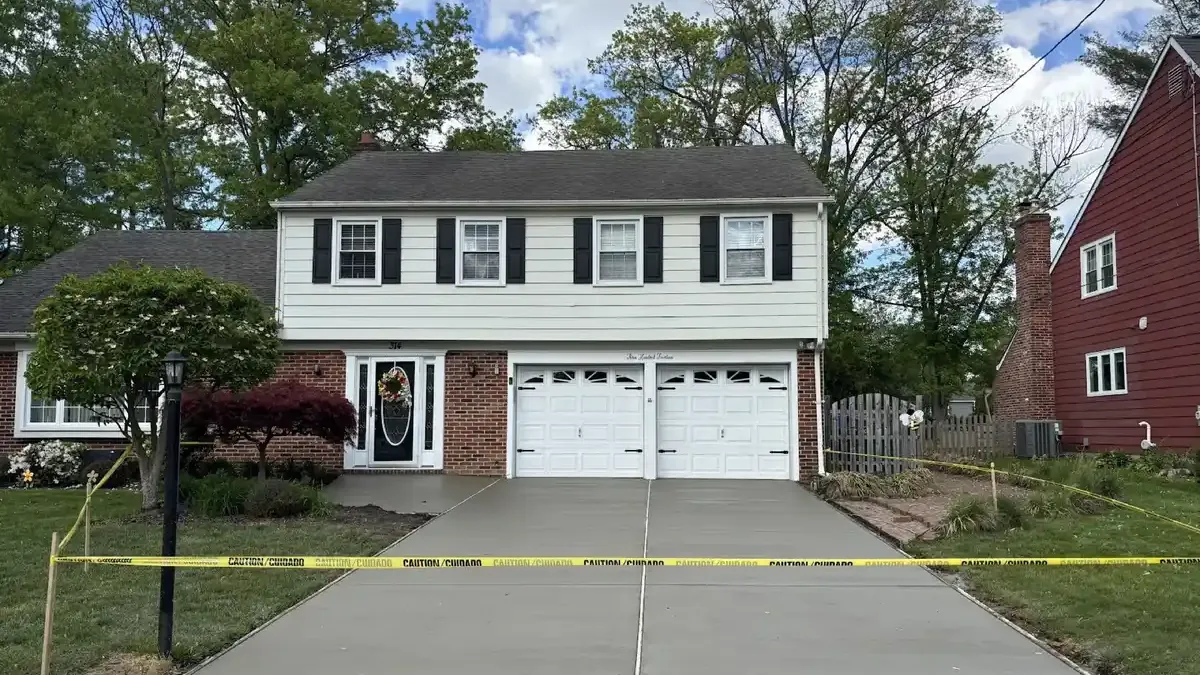
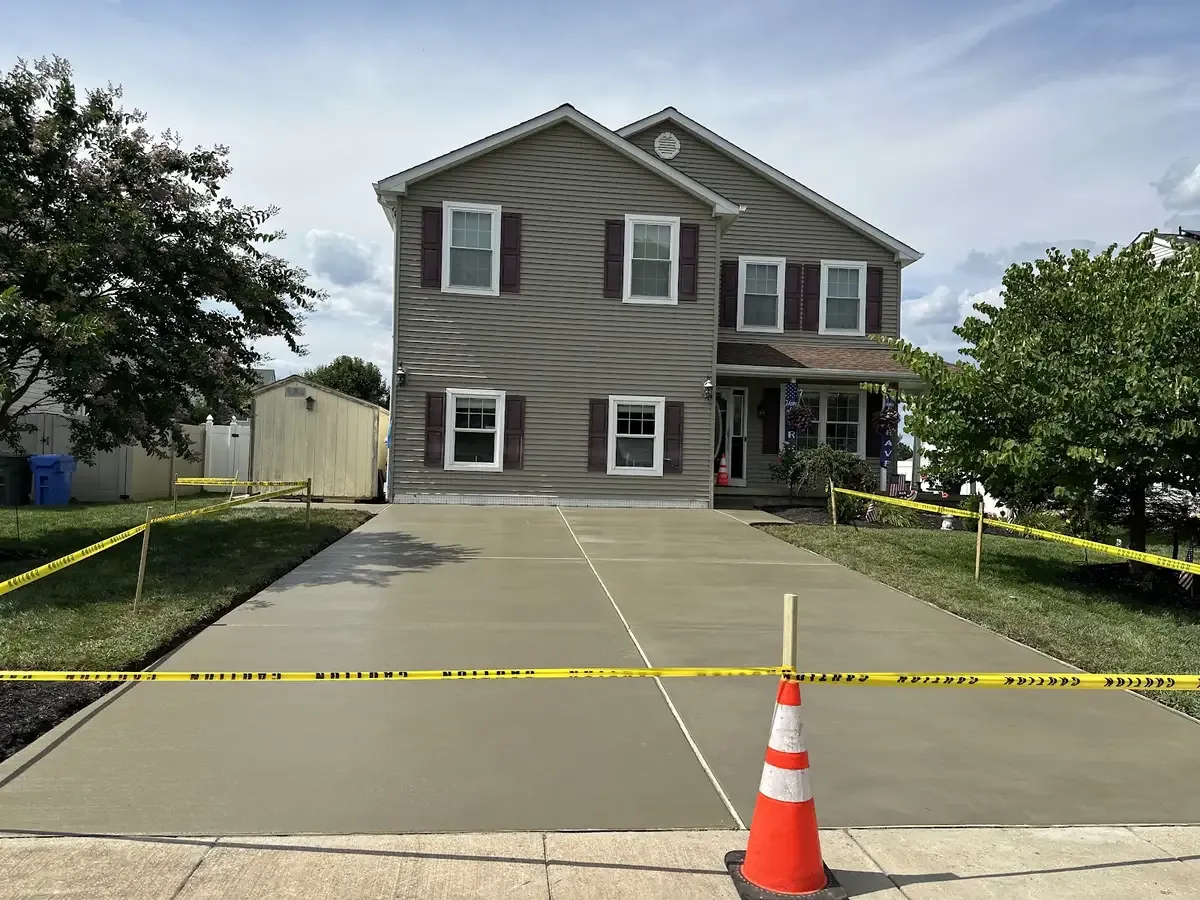
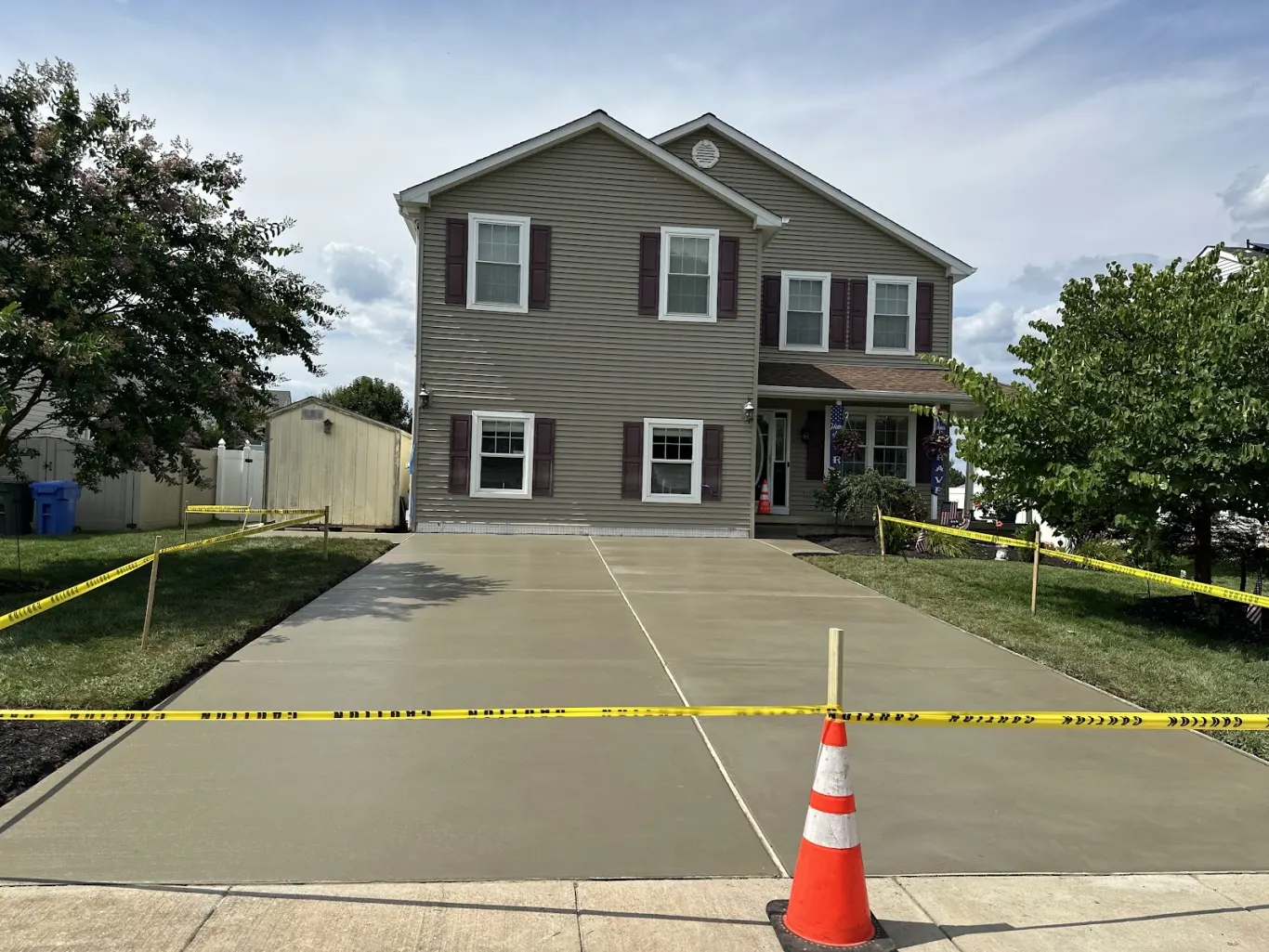
We tape off and cone a new driveway before we leave the job. The tape is not decoration. It is there because the person most likely to ruin a fresh slab is the homeowner who paid for it.
Temperature changes the whole schedule. Hydration, and with it strength gain, runs faster when it is warm, and placed concrete should be held above 50 degrees, according to the National Ready Mixed Concrete Association.
A driveway poured here in June is ready for a car sooner than the same driveway poured in late October. That is why we give you dates for your job instead of a rule of thumb.
We pour a 4500 PSI mix on every job. Most crews in this area pour 3500 to 4000. ACI Committee 330 asks for no less than 4,000 psi wherever freeze-thaw cycling and de-icers reach the slab, and recommends 4,500. South Jersey gets both every winter.
A slab left to dry out in wind and sun can lose as much as 50 percent of its potential strength compared with one that is kept moist, per NRMCA. A slab that was never cured properly is weaker on day 28 than the schedule says.
That is the real reason we never rush this part. The wait only works if the first week was handled right.
Ask the crew for dates before they leave, not a general rule. A good contractor will give you the day you can walk on it and the day you can park on it.
Write the pour date down. Four weeks from that date is your heavy traffic day, and it is easy to lose track once the forms come off.
Color is not a signal. Concrete goes light gray long before it is strong, and a slab poured in cool weather can look finished for three weeks while it is still coming up to strength.
Thickness changes what the slab can take once it is ready. Most residential driveways are poured 4 inches thick, and we step up to 5 or 6 inches with added reinforcement for work trucks and RVs. Our post on concrete driveway thickness covers where each one belongs.
The mix matters as much as the wait, and what a 4500 PSI mix is explains what that number buys you. How the slab was held wet in its first week matters too, which is covered in our guide to concrete curing methods.
Two more things buy a new slab years. Keep de-icing salt off it through its first winter, and ask about sealing once it has had time to dry out. Cracking has its own causes, and what makes concrete crack covers the ones you can control.
If you truly cannot keep a car off for a week, say so before the pour. We can talk through thickness, mix and timing while it still costs nothing to change.
Usually not. The standard advice is to wait at least 24 hours on a broom or trowel finished slab, and about 48 on stamped concrete. At 12 hours the surface is still soft enough to take a permanent footprint.
You get cracks that radiate out from the tire tracks, broken edges where the wheels crossed, and sometimes a dip that never comes back out. None of it is repairable with a patch. The section has to be cut out and replaced.
Concrete is tested and accepted at 28 days, and it keeps gaining strength slowly for months after that. For a driveway in Cherry Hill or anywhere else in South Jersey, 28 days is the day it can take anything you park on it.
We pour driveways, patios, sidewalks and slabs across Cherry Hill, Marlton, Mount Laurel, Moorestown and Haddonfield. Tell us what you are building and we will come measure it and give you the dates in writing.